How to Prepare for a Full Tech Interview Loop
A 4-week study plan for full interview loops at product companies — coding, system design, behavioral — built from the same prep we use inside the PathWand Tech Fellowship.
March 30, 2026 · 9 mins
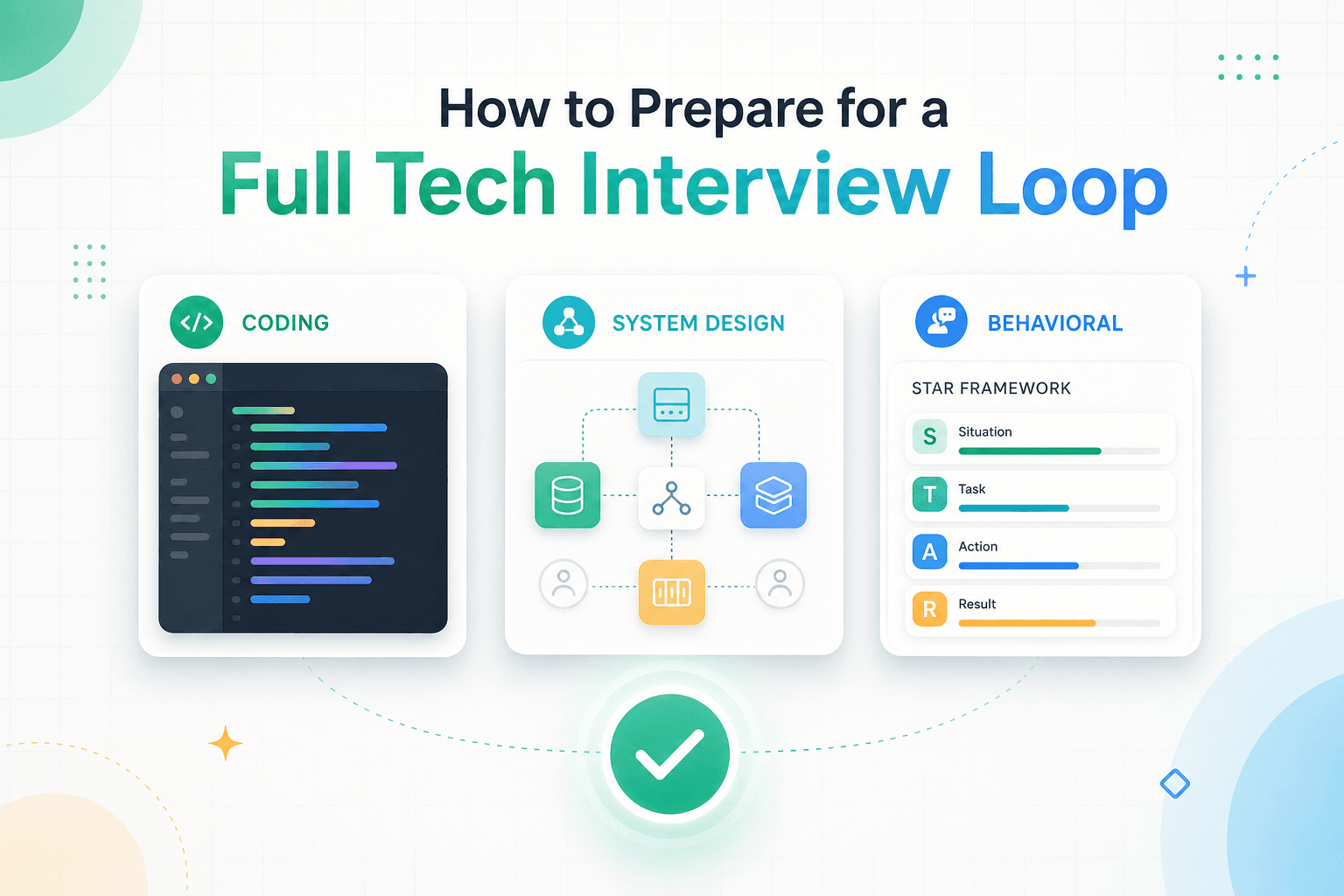
A study plan with a deadline
Most candidates study for tech interviews like they're studying for finals — pick up a textbook, do a few problems a day, and hope it sticks. That works fine for tests. It does not work for interview loops, where the distribution of questions is wildly different from what most resources assume.
Here's the 4-week plan we use inside the PathWand Tech Fellowship for engineers preparing for full loops at product companies.
Week 1 · Coding fluency, not coding novelty
The first thing recruiters and hiring managers calibrate on is coding fluency — your ability to write working code at speaking pace, not your ability to solve a hard problem.
Spend Week 1 doing:
- 15 easy problems across arrays, strings, hashmaps, sets — fast. Aim for one in 12 minutes including the test cases.
- 5 medium problems — but solve each twice. Once cold, once after a 24-hour break.
- No hard problems yet. That's a Week 3 thing.
The goal of Week 1 is to remove the friction of typing. By the end you should be able to write a for loop and
Map declaration without thinking.
Week 2 · The 8 medium patterns that show up everywhere
There's a remarkably small set of medium-coding patterns that show up in 80% of real interviews:
- Two pointers / sliding window
- Hashmap counting
- BFS / DFS on a grid
- Tree traversal (in/pre/post-order, level-order)
- Binary search on the answer
- Stack with monotonic invariant
- Heap for top-K / streaming median
- DP on intervals or sequences
Pick three problems for each pattern. Solve them, then do the same problems again 48 hours later. The point isn't to memorize — it's to make the pattern feel obvious when you see one variation in an interview.
Week 3 · System design, the right way
System design is where most candidates over-prepare on the wrong things. They'll memorize "Design Twitter" and then get asked "Design a feature flag system" and freeze.
The fix: study the building blocks, not the canned designs.
- Storage — when to use SQL vs NoSQL vs blob stores
- Caching — read-through, write-through, TTL strategies
- Queues — at-least-once vs at-most-once delivery
- Sharding & replication — what changes for reads vs writes
- APIs — REST vs gRPC vs WebSocket trade-offs
- Async patterns — pub/sub, fan-out, event sourcing
For each block, you should be able to draw it on a whiteboard and explain trade-offs in 2 minutes. With the blocks in hand, you can compose any design you're asked.
Week 4 · Behavioral, in your own voice
Behavioral interviews look easy and trip more candidates than any other round. The reason: when you don't have crisp stories ready, you reach for vague ones, and vague ones land flat.
Build a story bank of 8–10 stories from the last 3 years of work, each with the STAR structure:
- Situation (1 sentence)
- Task (1 sentence)
- Action (3–4 sentences — this is the meat)
- Result (1 sentence with a number where possible)
Common prompts to map each story to:
- A time you disagreed with your manager
- A time you missed a deadline
- A time you delivered something you were proud of
- A time you made a mistake
- A time you mentored someone
- A time you had to influence without authority
The point isn't to recite stories verbatim. It's to be 20 seconds away from any answer when the question comes.
The day before the loop
- Stop doing problems. You won't learn anything new in 24 hours.
- Re-read your story bank.
- Re-read 3 system design block summaries.
- Sleep eight hours. Seriously.
After every interview
Spend 10 minutes writing what you remember of every question — verbatim if possible. The fastest way to improve is to study the questions you actually got asked, not the ones the internet says you'll get.
Want structured prep with senior reviewers?
Our Tech Fellowship runs cohort prep with mock loops calibrated against the rubric of the company you're interviewing with. We pair you with senior IC reviewers who give you a feedback document after every loop. It's the difference between studying alone and studying with someone who's reviewed a thousand of these.
More from PathWand
7 Resume Rules That Actually Get You Replies
Recruiters spend an average of 7.4 seconds on a resume. After reviewing thousands of resumes through the PathWand resume review program, we distilled the rules that consistently move candidates from "applied" to "interview" — and the ones you can safely ignore.

The LinkedIn Profile Playbook for Engineers
Most engineering profiles on LinkedIn are technically accurate and emotionally invisible. Here's the PathWand playbook we use to triple recruiter outreach — without performative posts or buzzwords.
How to Prepare for a Full Tech Interview Loop
A 4-week study plan for full interview loops at product companies — coding, system design, behavioral — built from the same prep we use inside the PathWand Tech Fellowship.